
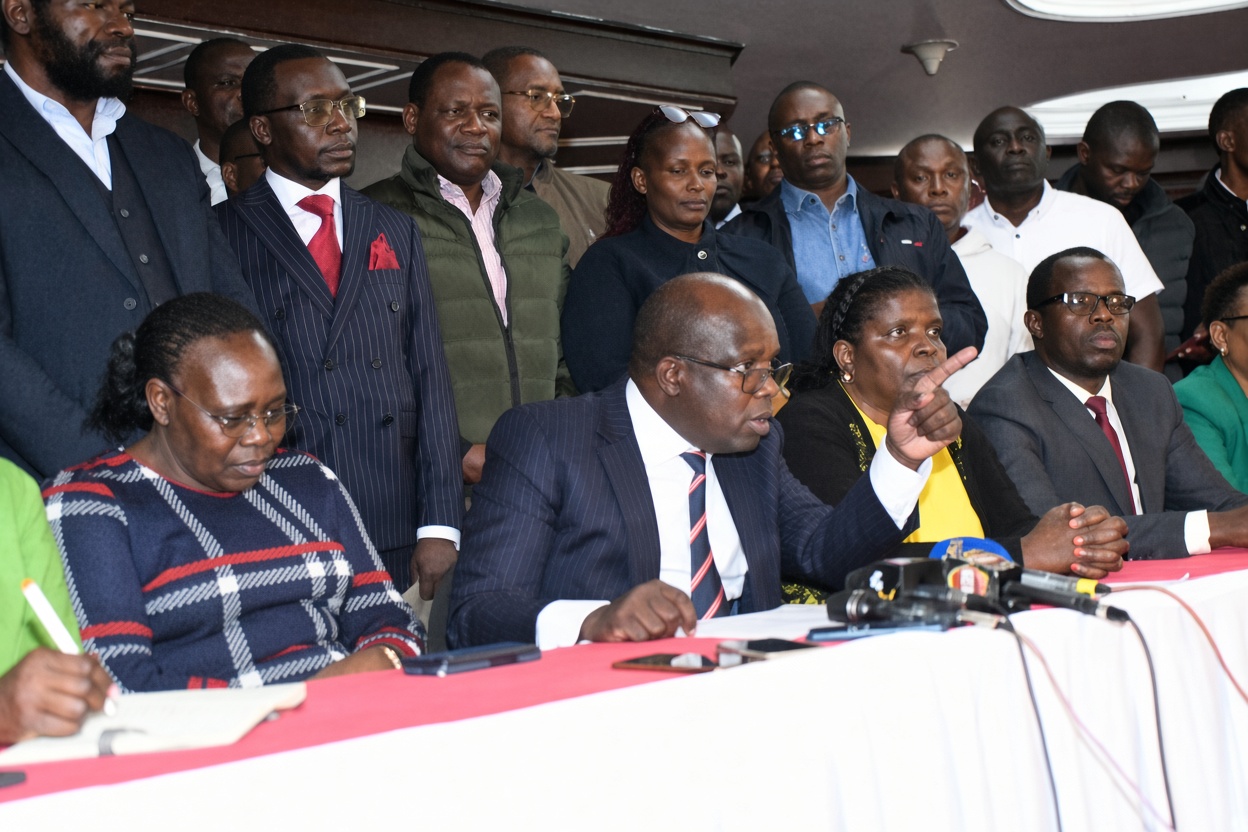
Nairobi, Kenya | September 18, 2026 — The University Academic Staff Union (UASU) has given the government one month to resolve outstanding issues affecting lecturers in public universities, warning that failure to conclude the 2025–2029 Collective Bargaining Agreement (CBA) could trigger a strike.
UASU Secretary General Constantine Wesonga said the union had extended its deadline after the Ministry of Education requested more time to address concerns raised by academic staff.
Speaking during a press briefing on Friday, September 18, following a National Executive Committee meeting attended by representatives from public universities and their constituent university colleges, Wesonga said the government has until October 18, 2026, to conclude the CBA negotiations.
“I have said we have given them one month. We call upon the government to intervene urgently and resolve these matters before the damage to university education becomes irreversible. After 18th, we shall not listen that we give dialogue a chance,” Wesonga said.
He said the decision to delay issuing a strike notice followed a meeting with the Ministry of Education on Thursday, September 17, during which the union was asked to allow more time for discussions.
“And the reason why I have not called a strike today is because our mother ministry called us. When was that? Yesterday. And they told us to give them time. We have given them exactly one month. 18th today up to 18th of October,” he said.
The union warned that failure to conclude the 2025–2029 CBA by the October 18 deadline would result in the issuance of a strike notice.
“Failure to conclude this 2025–2029 CBA, UASU will serve as a strike notice,” Wesonga said.
UASU Raises Concerns Over Stalled CBA Talks
The union also raised concerns over what it described as delays in the ongoing negotiations, with the Secretary General accusing the Inter-Public Universities Consultative Forum (IPCCF) of contributing to the impasse.He claimed that some representatives appointed to the negotiating table lacked experience in implementing CBAs in their respective institutions.
“IPCCF has sent to the negotiating table negotiators who do not believe in CBA negotiation. Virtually all the vice-chancellors we are negotiating with at Machakos do not have CBAs in their respective chapters. So they were sent there to come and stall this CBA,” he said.
The union further questioned what it described as similarities between recommendations from the IPCCF and advice issued by the Salaries and Remuneration Commission (SRC).
“If you check IPCCF recommendation, it is word for word advice from SRC. We thought SRC is an independent commission,” Wesonga said.
He maintained that the SRC should provide independent advice while allowing the government and the union to negotiate freely, rather than presenting what he described as a final position.
UASU Rejects Funding CBA Through Student Fees
UASU also rejected proposals that would link the financing of lecturers’ salaries and CBA benefits to student fees under the current university funding model.
The union argued that academic staff are public employees and that their salaries and negotiated benefits should be financed by the Exchequer.
“The union is saying, we are not going to accept our CBA to be funded from student fees. We are public employees,” he said.“Our salaries should come from the Exchequer, not student fees.”
The union questioned the sustainability of such a funding arrangement, particularly in cases where students fail to meet their fee obligations.
“Suppose students don’t pay fees like they have not paid now? What will happen to our salaries?” he asked.
UASU Defends Lecturers Over Workload and Retirement Age
The union also challenged what it described as a misconception that lecturers’ workload should be measured solely by classroom teaching.
“The work of a professor is to teach, research, and do community service. So workload is not backed only on teaching. Divide the workload, teaching, research, and community service,” Wesonga said.
He further opposed efforts to retire professors without taking into account their broader contribution to universities and society.
“So if you tell a professor to retire, in essence you are telling him to stop thinking. Professors are taught to think for the country,” he said.
The UASU Secretary General said the union would continue pushing for the interests of academic staff and would not accept what he termed unfair terms in the ongoing CBA negotiations.
He reiterated that October 18 would mark the next major deadline in the dispute, with the union maintaining that it had given the government one month to resolve the outstanding issues.