
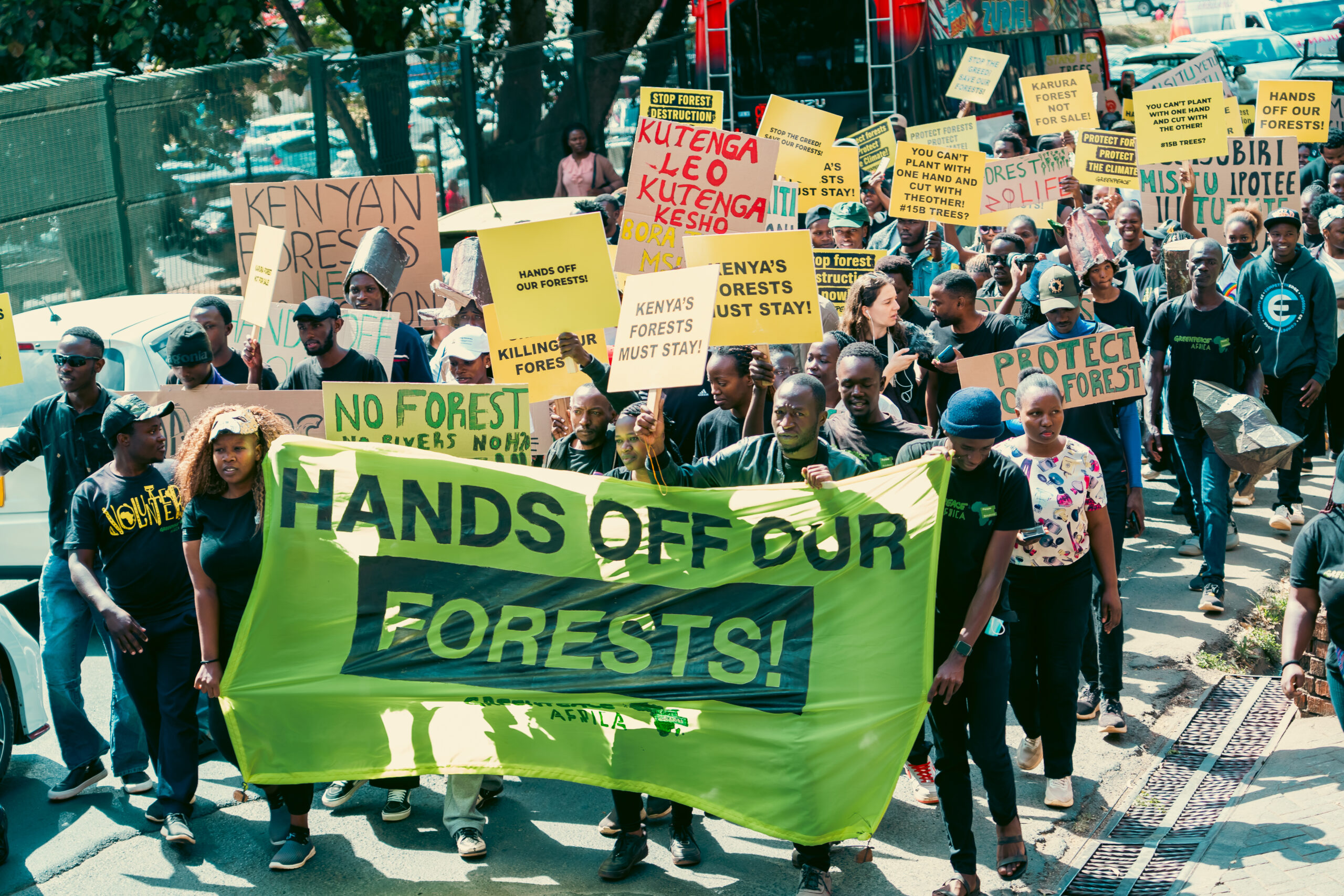
NAIROBI, Kenya | October 6, 2026 — More than 60,000 Kenyans have petitioned the government to take immediate action to stop deforestation, illegal logging and the alleged grabbing of public forest land across the country.
The petition was handed over on Tuesday, October 6, following a march organised by Greenpeace Africa, the Green Belt Movement, Just Act, Friends of Nairobi National Park, environmentalists and other civil society organisations.
The procession started at Uhuru Park in Nairobi and proceeded to the Ministry of Environment, Climate Change and Forestry offices at the former National Hospital Insurance Fund (NHIF) Building along Ragati Road in Upper Hill.
In an open letter accompanying the petition and seen by The Daily Brief, the organisations said the more than 60,000 signatures represented Kenyans concerned about the continued loss and degradation of forests.
They described Kenya’s forests as critical water towers that support rivers, agriculture, industries, wildlife and the livelihoods of communities living around forest ecosystems.
“Kenya’s forests are our water towers. They feed the rivers that supply our homes, farms and industries, regulate rainfall and support the livelihoods of millions of people, especially forest-adjacent communities who have protected these landscapes for generations,” the organisations stated in the open letter.
Groups Raise Concerns Over Forests and Protected Areas
The organisations highlighted several forests and protected areas where they claimed development projects, proposed land allocations, logging and other activities were threatening conservation efforts.
Among the areas cited was Imenti Forest, where the groups raised concerns over the proposed excision of 2.75 hectares following concurrence issued by the Principal Secretary for Forestry on May 6, 2026.
They linked the area to reported plans for an airstrip, golf course and State Lodge, while alleging that work at the airstrip site continued despite a court order blocking construction.
The petitioners also raised concerns over developments at Nairobi National Park, particularly the relocation of the Nairobi Animal Orphanage and plans for a 1,300-vehicle parking facility.
According to the groups, tree felling and clearing have taken place in an area designated as a Low Use Zone under the park’s management plan.They noted that 4,642 Kenyans had moved to court over the matter and alleged that petitioners were prevented from participating in a court-ordered site inspection in July.
At Ngong Road Forest, the organisations cited the entry of heavy machinery in July 2026 to clear a road linking Talanta Stadium to Bomas, as well as the construction of an eco-lodge inside the Sanctuary Block.
The Environment and Land Court subsequently issued conservatory orders halting both activities in a case involving the Law Society of Kenya, the Green Belt Movement and JustAct.The petitioners also raised concerns over activities at Karura Forest, where trees were cleared around Rangers Village in February 2026 to facilitate accommodation for National Youth Service personnel.
They said Friends of Karura, the forest’s legal co-manager under a joint agreement running until 2041, was not consulted before the project.According to the organisations, the government later agreed to halt the project following a meeting with the Ministry in March.
They are now calling on the Ministry to publicly confirm that commitment and restore the cleared section to indigenous forest.
‘Fifteen Billion Trees Cannot Replace Natural Forests’
The petitioners acknowledged the government’s 15 billion tree-growing programme, which seeks to increase Kenya’s national tree cover to 30 per cent by 2032.
However, they argued that tree planting should not be used as a substitute for protecting existing natural forests.The groups said newly planted seedlings cannot immediately perform the ecological functions of indigenous forests that have developed over centuries.
They called for greater focus on forest protection, arguing that increasing tree-growing figures while natural forests continue to face degradation would undermine the country’s conservation efforts.
“Growing tree cover while shrinking our forest cover is a contradiction. Kenyans can see it clearly. The government asks citizens to plant trees while its own agencies clear protected forests, excise forest land and reopen water towers to logging. Planting and protecting must go together. Without protection, planting becomes a numbers exercise that hides the loss of the forests we already have,” the petitioners said.
Petitioners Demand Action Against Forest Destruction, Illegal Logging and Land Grabbing
The petitioners have called on the Ministry of Environment, Climate Change and Forestry to take urgent measures to protect Kenya’s forests.
Among their demands is the halting of what they describe as destructive projects in Imenti Forest, Nairobi National Park, Ngong Road Forest, Karura Forest, Suam Forest and other protected areas, while ensuring that all court orders are respected.
They are also demanding the reinstatement of the logging ban in the Mau Forest Complex, alongside stronger forest governance and meaningful community participation.
The groups want the government to publicly disclose all excisions, easements and licences affecting public forests and involve community forest associations and forest-adjacent communities in decisions concerning the forests.
They further want authorities to take firm action against illegal logging and land grabbing by investigating and prosecuting those responsible and recovering public forest land.
Petitioners Give Government 30 Days to Respond
The petitioners have given the Ministry 30 days to provide a written response to their demands, stressing that forest conservation must go hand in hand with tree planting.
They said the campaign was not only about growing more trees but also about protecting the forests that already exist.
The petition comes ahead of the October 10 Mazingira Day celebrations, with environmental groups urging the government to use the occasion to outline concrete measures to protect Kenya’s remaining natural forests from illegal logging, land grabbing and destructive development.
The groups said more than 60,000 Kenyans, alongside many others supporting the campaign, would be watching how the government responds to the demands.