
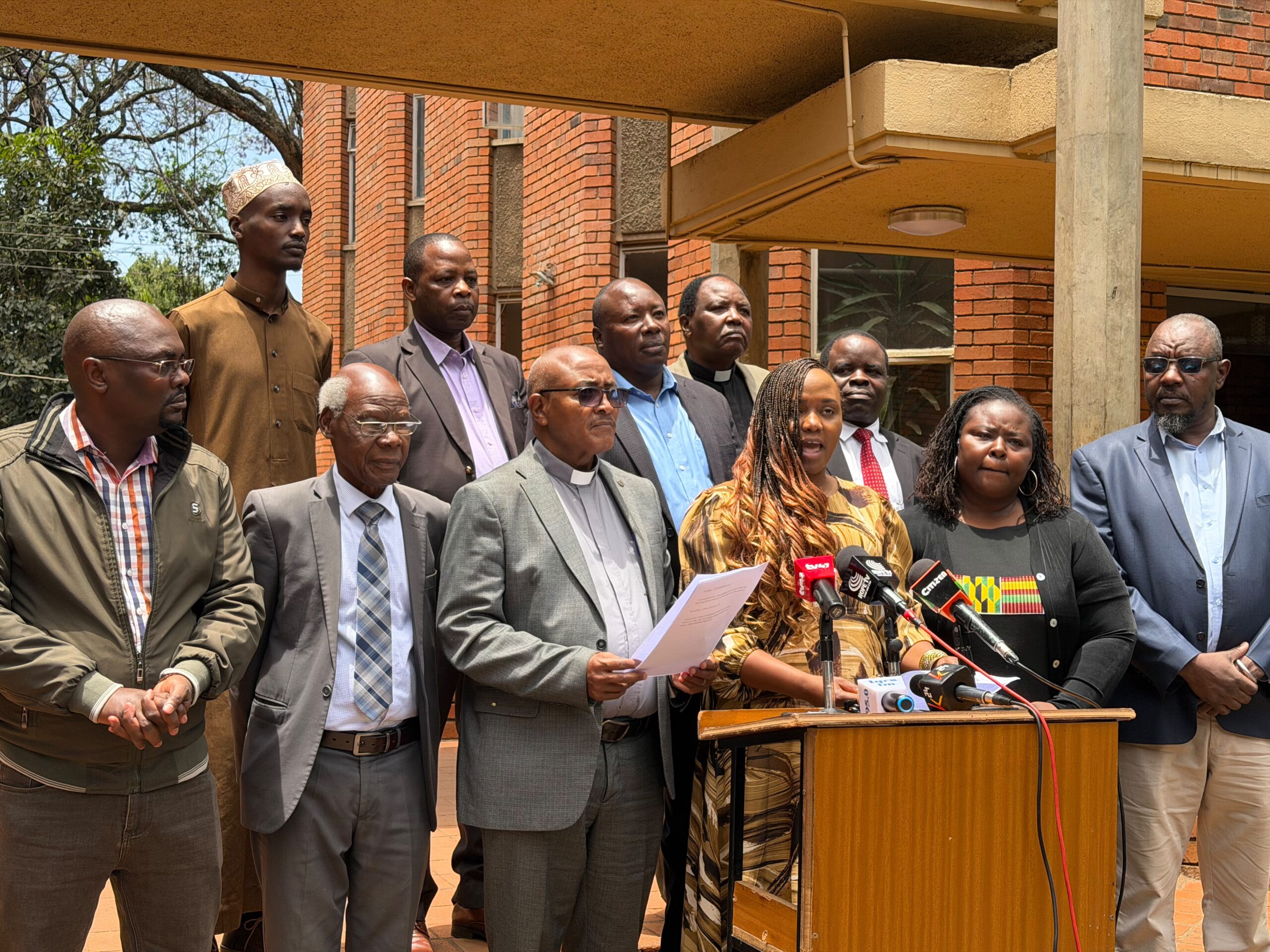
Nairobi, Kenya | October 13, 2026 — Religious leaders and civil society organisations have challenged proposed KSh 10 million vehicle grants for judges, warning that the benefits could place an additional burden on taxpayers and divert public resources from essential services.
The coalition is urging the Supreme Court to scrutinise the disputed benefits and clarify the constitutional framework governing judicial remuneration, arguing that judicial independence must be balanced with fiscal sustainability, transparency and public accountability.
Speaking during a joint press briefing on Tuesday, Diana Gichengo, Executive Director of The Institute for Social Accountability (TISA), said Kenyans should not bear the cost of public benefits without sufficient justification.
“Kenyans must not be fleeced by an unholy union of power. The constitution must bind everybody,” Gichengo said.
She warned against what the coalition described as an “unholy union” involving Parliament, the Executive and the Judiciary, arguing that the institutions responsible for safeguarding public interest should not enable privileges that expose taxpayers to additional costs.
“Kenyans are at risk of being fleeced by an unholy union of parliament, the executive, and the judiciary when the institutions entrusted with protecting the public interest instead preside over, enable, or defend privileges at public expense,” she added.
The organisations said the dispute comes at a time when households are struggling with the rising cost of living, unemployment, school fees, healthcare expenses and the tax burden.
“At a time when citizens are struggling with the cost of living, unemployment, school fees, healthcare costs, and an unsustainable tax burden, the question is simple. Who is protecting the Kenyan taxpayer?” Gichengo posed.
Coalition Estimates Judges’ Car Grants Could Cost KSh 2.3 Billion
Transparency International Kenya Executive Director Sheila Masinde said the coalition estimates that the proposed KSh 10 million vehicle grant could cost approximately KSh 2.3 billion before tax, or KSh 1.61 billion after tax, every four years, based on the judicial positions covered by its available figures.
She clarified that the figures were estimates based on available data and assumptions, rather than confirmed expenditure or a determination of the grant’s legality.
“These are estimates based on the available figures and assumptions, not confirmed actual expenditure or a determination of the grant’s legality,” Masinde said.
The coalition also questioned the necessity of the benefit, noting that judges have access to official chauffeur-driven transport while the disputed grant is intended to facilitate private vehicle use.
Masinde said the estimated KSh 1.61 billion after tax should be considered against competing national priorities, including healthcare, education, water provision, agriculture and access to essential medicines.
“1.61 billion Kenya Shillings is not an abstract accounting figure. It is money raised from Kenyans through taxation and public revenue. It is money that could otherwise contribute to frontline health services, school infrastructure, essential medicine, water, agricultural support, and other much-needed public priorities,” she said.
The coalition maintained that public expenditure decisions should account for their opportunity cost, particularly when the government faces competing demands for limited resources.
Religious Leaders Cite Constitution in Judges’ Remuneration Debate
Rev. Eustace Kabui, representing the Presbyterian Church and the Ufugamano Joint Forum for Religious Organisations, said judicial independence was essential to protect judges from intimidation, political interference and financial retaliation.
However, he cautioned that the principle should not be used to shield judicial remuneration and benefits from constitutional scrutiny.
Kabui cited Article 230 of the Constitution, which establishes the Salaries and Remuneration Commission (SRC) and outlines its mandate to set and regularly review the remuneration and benefits of state officers.
He also referred to Article 230(5), which requires the commission to consider principles including fiscal sustainability, transparency, performance and the attraction and retention of skilled personnel.
At the same time, Article 160(4) protects judges against disadvantageous variation of their remuneration and benefits. Kabui argued that both provisions must be respected as the courts consider how to protect judicial independence while ensuring public remuneration remains fair, equitable and accountable.
The coalition also cited previous High Court and Court of Appeal rulings in the Gashweri case, calling on the Supreme Court to clarify the relationship between judicial independence, remuneration and public accountability.
It further urged the court to ensure that any potential conflicts of interest are addressed in accordance with the law, saying public confidence in impartial justice must be protected.
Churches Demand Accountability in Public Spending
Rev. Bishop Patrick Musungu Lihanda, a senior clergy member at Friends Church, Kenya, said the dispute was not about denying judges fair remuneration but determining whether the proposed vehicle benefit was legally justified and equitable.
“The issue is not whether churches deserve fair remuneration. They do. The issue is whether a private vehicle benefit of this magnitude is legally justified, equitable, and defensible to citizens who finance the state while struggling to meet their basic needs,” he said.
Lihanda called for constitutional scrutiny of public benefits, citing Article 201, which sets out principles governing public finance, including accountability and the prudent use of public resources.
“Public money is a public trust, not an entitlement to be expanded without justification,” he said.
Meanwhile, Inuka Kenya Ni Sisi Chief Executive Officer Dr. Kawive Wambua urged Kenyans to demand accountability from public institutions while maintaining confidence in the Judiciary.
“Our demand is not for a weakened judiciary. No, it is for a judiciary whose independence is matched by integrity, whose authority is matched by humility, and whose decisions strengthen public confidence in the rule of law,” Wambua said.
“Let the constitution bind everyone equally. Let public money serve the public good. Let no institution place itself above the people whose sovereignty gives it authority,” he added.
The coalition reiterated that judicial independence and public accountability should operate together, rather than be treated as competing principles.
The organisations said they were seeking to join the Supreme Court proceedings involving the SRC as amicus curiae (friends of the court) or interested parties to present their views on the disputed vehicle benefits.
They maintained that their intervention was intended to promote transparency, constitutional accountability and responsible use of public funds while safeguarding the independence of the Judiciary.